‘Climate Superfunds’ Are Blowing Up Energy Bills
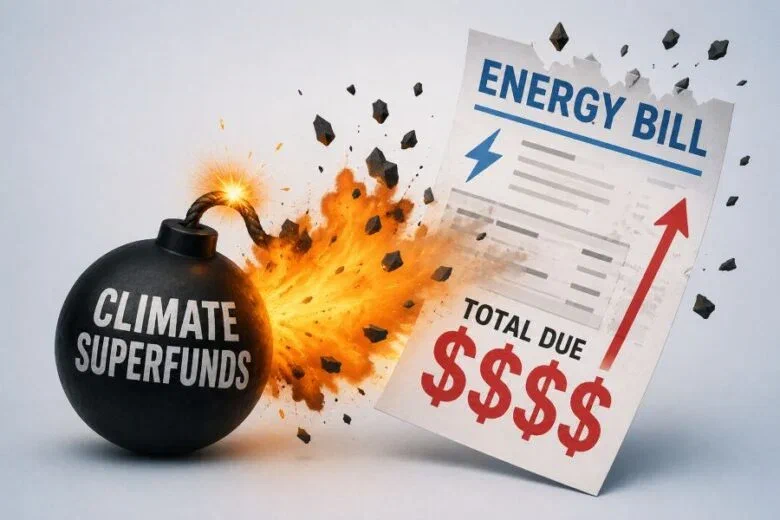
Vermont passed it first. New York followed with a $75 billion price tag attached. Now Minnesota wants in, and at least nine more state legislatures have similar bills in the queue.
The “climate superfund” concept, which imposes retroactive penalties on energy producers for emissions stretching back decades, is no longer a one-state experiment; it’s a coordinated effort to reshape American energy policy not through Congress but through an expanding web of state-level liability laws.
That is what makes it a federal problem, one we’re all paying for each month in our utility bills.
The premise of these laws is akin to a blindfolded monkey throwing a dart at stock picks. A state legislature picks a lookback period (Minnesota chose 1995), assigns a share of global emissions to specific energy companies, and demands billions in fees to fund future “climate resilience.” It’s a shockingly bold scheme.
Vermont’s law took effect in 2024, and New York’s version is expected to raise $75 billion over 25 years. Minnesota’s projected first-year haul nears $16.5 billion, or $7,000 per family annually.
Whatever proponents call these statutes, the national effect is the same. Energy markets don’t stop at state lines, so when one state rewrites the rules for major producers, every state feels it at the pump and on the power bill. These laws also sit in uncomfortable legal territory, bumping up against the Clean Air Act’s preemption framework, which exists precisely to keep a patchwork of state regulations from overriding federal energy policy.
There is no version of this where producers absorb tens of billions of dollars in new liability and don’t pass it on. Gasoline, electricity and everything that depends on both will cost more.
The National Federation of Independent Business has warned that small businesses and consumers who rely on energy, rather than oil giants, will end up holding the bag. A climate group promoting these laws even acknowledges in its activism toolkit, “If companies claim they can’t afford to pay — without raising prices — that’s a clear sign we need to accelerate the transition to cleaner energy sources.”
The point is to raise consumer costs as political leverage to promote alternative energy.
In April 2025, President Trump issued an executive order directing federal agencies to challenge state climate-superfund laws as unconstitutional. The Justice Department then challenged Vermont’s law, with more than 20 state attorneys general intervening. An additional 22 states have separately sued New York over its statute. In August 2025, a South Carolina judge dismissed the city of Charleston’s parallel climate suit with prejudice, finding it an unconstitutional attempt by one state to regulate conduct that occurs everywhere.
The legal theory underneath all of this is collapsing in real time because judges can see through the ideological efforts to reshape energy policy through local courts. This sort of lawfare must be defanged.
Congress can torpedo these “climate superfund” laws for good, and Sen. Ted Cruz, R-Texas, and Rep. Harriet Hageman, R-Wyo., took the first step by introducing the Stop Climate Shakedowns Act to preempt these state schemes outright. Federal preemption is the cleanest fix: a narrow, Section 230-style liability shield for lawful energy production that preserves accountability for actual fraud, spills and environmental violations while keeping plaintiff lawyers and state attorneys general away from crafting national energy policy.
Twenty-six words created the modern internet by drawing that line. A similar provision could spare consumers from a patchwork of energy taxes dressed up as tort claims.
The stakes are not just high for Minnesotans or New Yorkers. If the superfund template survives, the next decade of American energy policy will be written by trial lawyers, attorneys general and a handful of out-of-state philanthropies bankrolling the litigation pipeline.
The situation in Iran and the Strait of Hormuz may be driving energy price spikes this spring and summer, but in the long term, this shadow tax on consumers receives far less scrutiny.
While affordability is on the tip of everyone’s tongue in politics, there is no better way to address it than for Congress and the Justice Department to stop the climate lawfare. With five months until the midterms, the administration has no time left to waste.
Published in DC Journal (archive #1, #2) and syndicated in the Boston Herald (archive #1).