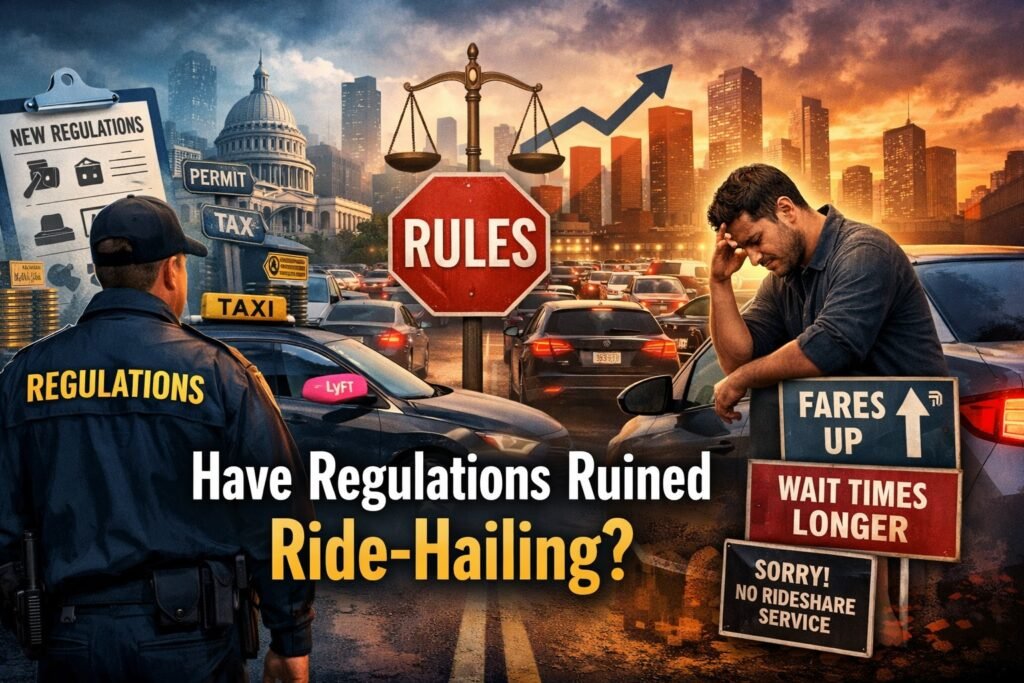
Regulations ruined ride-hailing, Vienna edition.
Since 2021 in Austria, all ride-sharing, ride-hailing, and “digital dispatch” apps (services like Uber and Bolt) are regulated as taxi services.
For anyone to drive another person for money, no matter the arrangement, they are required to hold a Taxi license.
This was passed by the Austrian Parliament in 2020, under the ÖVP-Green coalition, mainly as an initiative of the Green party to ensure “fair competition under equal conditions”.
Overnight, it made all ride-hailing platforms into taxi apps, and took away the innovative nature of what these apps offered by cementing them into the status quo. This has been worse for consumers and riders.
For riders, these services are basically all merged into one: Bolt, Uber, FreeNow, Taxi dot eu, etc. Practically, as riders know, drivers usually have each of these apps and are constantly scanning each for riders. They are required to use professional car services rather than personal cars, and thus must pay for various fees, rents, insurances, and licensing that artificially raise the of fares.
Rather than go through a complicated policy brief, let me just offer my personal experience as a rider and user of these apps.
It’s only gotten worse
How is it working in practice? Consumers are paying more, competition is virtually non-existent, and it’s getting harder to just get a ride at a decent price for every tourist or resident.
Arriving on a flight to Vienna airport, you can order one of these cars on the upper level (paradoxically, the departures area), marketed to arriving tourists as the “Uber” area.
Because drivers are on all apps, and they’re all forced to be licensed taxi drivers that are usually renting from a professional car service plus pay a percentage of their fare to the apps, they have very high input costs with each ride. A new airport fee charges drivers at the “departures” area if they hover for more than 10 minutes, so this is also added to each fare.
If you arrive at a particularly busy time, imagine a Sunday or Monday evening, a rider can expect to pay around 40 EUR or more for a ride to the city center. More if it’s an outer district. However, this is the floor price, and one that is RARE for any rider to pay.
Because drivers are on all apps, and have very high fixed costs, 40 EUR is no longer reasonable for any of them. Even if Uber, Bolt, or FreeNow offer the rides for 40 EUR or 45 EUR depending on the type of car, there are no reasonable drivers who are accepting these rates. This creates the following scenario:
If you’re there at a busy time, drivers will “pass” on your fare set at the rate chosen by these apps. Your app will continue “searching” for a driver until they accept the rate, and you will be stuck in an endless cycle. I was told by a driver that they no longer accept anything under 50 EUR.
Because drivers have now set a floor price of ~50 EUR when they accept on the app, they approach riders and pitch them directly for cash fares at a 5 EUR discount or more, so they could underreport their fares to their tax service and pocket more money. This isn’t inherently wrong or illegal, but it’s expected. The regulatory input costs have made driving less affordable, and thus any driver worth a salt will aim to arbitrage for a larger payout. Simple economics.
What does this mean for a tourist?
For the simple tourist arriving in Vienna, it means that they’re stuck waiting for a car at the recommended price, sometimes for 30-40 minutes. Many will just give up and take the train or other public transport, strike a private agreement with a driver who approaches them, or make their way downstairs to use the Airport-approved taxi stand where you pay by meter.
For riders, this defeats the purpose of using these innovative apps. When you book a ride using an Uber or Bolt, you see the price beforehand, you can use your credit card within the app, you have tracking enabled that allows you to follow the route and share with friends and family, and you have business-friendly invoicing for people who may be traveling for work. These are all advantages that made these apps attractive to users in the first.
But because the input costs due to regulations have increased so high, we’re basically just using common Taxi services through a plethora of different ride-hailing apps and have driving the cost upwards to be frankly unaffordable for a person of modest means.
This has happened everywhere
Vienna is no by means special nor different. Hundreds of cities and countries have implemented rules like this to defang the ride-hailing companies and give a “level playing field” for the traditional taxi lobby. In some cases, the ride-hailing companies have opted to fight the rules to defend affordable rides for customers and attractive ride offers for drivers. In many other cases, however, regulatory pressure has been too immense and they risked being banned totally.
This spirit and main consumer advantages of the sharing economy have been the target of powerful lobbies ever since their inception. We see this regulatory creep affecting the consumer experience with any service that once was innovative: Airbnbs are no longer affordable nor attractive, Uber rides are shockingly expensive, and food delivery apps are tacked on with so many taxes and fees imposed by municipalities that we are paying double to get burritos to our door.
Everyone recognizes these facts, but we often misdiagnose them as somehow the “greed” or “incompetence” of innovative sharing economy companies. Wrong. Rather, it’s due to the excessive regulatory regimes that we’ve allowed to capture these services and make them frankly unusable, degrading the consumer experience of simply booking a car, renting an apartment or home, or trying to get food delivered when the weather is terrible outside.
There’s a better way
There’s a better way, and that’s what Consumer Choice Center has been fighting for since our inception in 2017.
If you want to learn more about how regulations imposed by cities and countries impact your experience with the Sharing Economy, be sure to read our latest Index where we rank cities by their friendliness to these services, and provide lessons for better rules and regulations so innovation and competition, rather than entrenched interests, can thrive.
originally published on X, then on the Consumer Choice Center’s website.