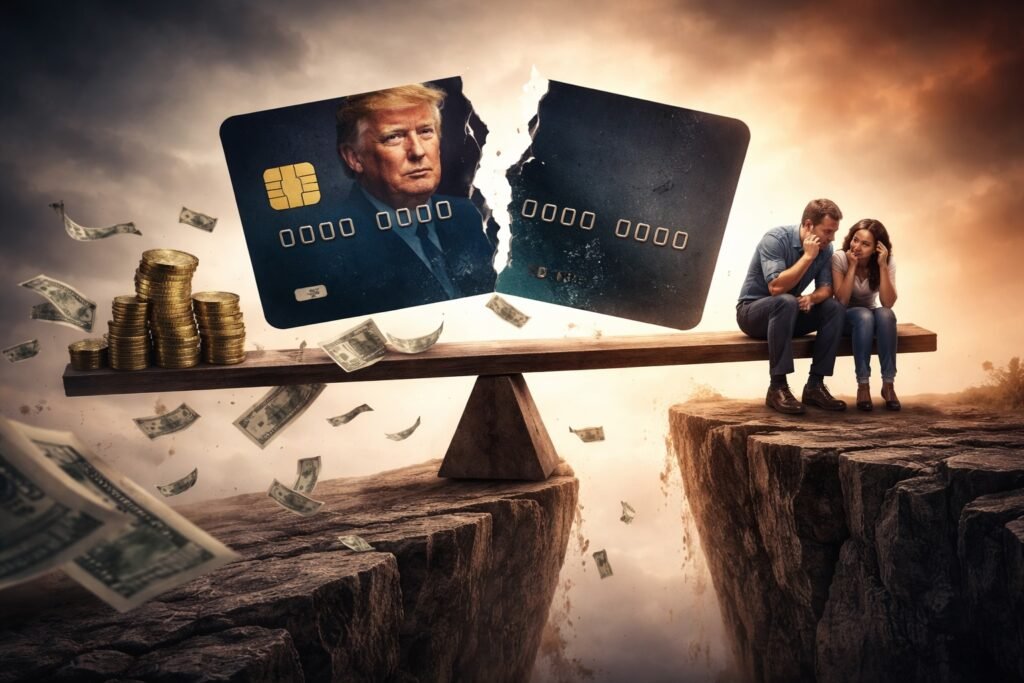
President Trump started 2026 with new fights on many fronts, including one that may even excite the left-wing flank in Washington — a battle with the consumer lending industry. On Truth Social last week, the president declared Americans will no longer be “ripped off” by the credit card industry, endorsing a one-year cap on interest rates at 10 percent.
Legal and constitutional questions aside, although this latest Trumpnomics move may win favor in some corners of the midterm electorate, the idea is not particularly new. In fact, it’s ripped directly from a bill introduced last year by populist duo Sens. Bernie Sanders (I-Vt.) and Josh Hawley (R-Mo.), which proposes a permanent federal 10 percent annual percentage rate cap on personal credit cards.
Rather than put the hurt on big banks, though, Trump’s move will merely limit many Americans’ access to credit. Others will be cut off entirely.
Everyone wants lower interest rates, but the question to policymakers must ask is, at what cost? As a pure state intervention into private credit markets, Trump’s move functions as a government price control. History repeatedly shows that price controls don’t protect consumers — instead, they shrink the market, reduce access, and hurt the very people they claim to help.
For tens of millions of Americans, credit cards help cover emergency expenses, smooth out income volatility, and build credit history that unlocks future financing opportunities. The interest rates on those cards reflect the bank’s risk, not moustache-twisting corporate villainy. When lawmakers artificially lower that price, lenders don’t absorb the loss out of goodwill — they respond rationally by lending less.
That’s the inconvenient truth Trump ignores. A 10 percent cap makes it economically unwise to offer credit cards to borrowers with imperfect credit. Financial institutions would exclude them and probably also ratchet down their perks, do away with popular rewards programs, and raise fees for everyone else.
Those who can easily get and use credit will be fine, as always. Everyone else won’t be.
We’ve seen this movie before. States and countries that impose aggressive interest-rate caps don’t eliminate high-cost borrowing — they just drive it underground or offshore, where fewer consumer protections exist. We have plentiful evidence from recent failed experiments in interest caps in Illinois and in the nation of Chile.
Despite the evidence from both markets, Trump is likely to find quiet support on the left, not just in politics but in academia as well. The most-cited academic contribution on capping on credit card interest rates was produced last year by Vanderbilt University’s Policy Accelerator program.
Their argument rests on the supposed high profit margins of credit card issuers alone, which the researchers argue would be large enough to absorb and even offset the impact of less revenue from interest.
In their view, the economic impact of capping interest rates on credit cards would only be marginal, forcing credit issuers to seek profits elsewhere and passing savings on to consumers. Even in their own analysis, the most enthusiastic supporters of a 10 percent cap recognize this isn’t a free lunch.
But it is unrealistic to think banks would just trim marketing or rewards. Decades of evidence show that rate caps usually shrink credit access by double digits and harm borrowers’ financial well-being. In practice, this 10 percent credit-card cap would slam the door shut on at least 14 million Americans, particularly those with modest incomes who rely on revolving credit for everyday necessities.
The populist right has joined the left in their ire over credit-based lifestyles, demonstrated by Tucker Carlson’s final show with Charlie Kirk weeks before Kirk’s assassination, which focused heavily on their shared disdain for the credit industry.
Nevertheless, basic economics remains undefeated. When the government mandates prices below market reality, supply dries up. In housing, that means shortages. In energy, it means blackouts. In credit, it means a perilous squeeze, and consumers feel it first when they can’t get any.
Enacting new laws or restrictive limits to reduce credit access to all Americans is not a reasonable solution. Policymakers should focus on credit transparency and financial literacy as much more effective measures to tackle the debt problem. Encouraging personalized payback plans, for one, would actually help real people struggling with debt spirals.
Social media influencers and educators like Dave Ramsey and Caleb Hammer, teaching Americans about how to better budget and eliminate debt, are doing wonders for their audiences. Debt can be a real problem for some people, but debt also solves short-term problems, freeing others to make better long-term moves.
Trump is flirting with a feel-good policy that looks compassionate yet functions like a financial freeze. That’s exactly what a credit cap threatens to do — turn a complex consumer marketplace into a government-run monstrosity.
Yael Ossowski is deputy director at the Consumer Choice Center and author of “The Perilous Credit Squeeze: Why Credit Card Interest Rate Caps Harm Consumers.”
Published in The Hill.